
For Therapists
Education & Support
Your Journey to a Fulfilling Life
“We don’t have to do all of it alone. We were never meant to.” — Brené Brown
Education & Support for Therapists
Education & Support
for Therapists
“We don’t have to do all of it alone. We were never meant to.” — Brené Brown
Therapy for Therapists
As therapists, we hold space for others every day – but who holds space for us? Seeing your own therapist provides a safe place to process the emotional weight of your work, gain perspective, strengthen your resilience, and help you show up more fully for both yourself and your clients.
Therapy for Therapists
As therapists, we hold space for others every day – but who holds space for us? Seeing your own therapist provides a safe place to process the emotional weight of your work, gain perspective, strengthen your resilience, and help you show up more fully for both yourself and your clients.
Workshops and Education
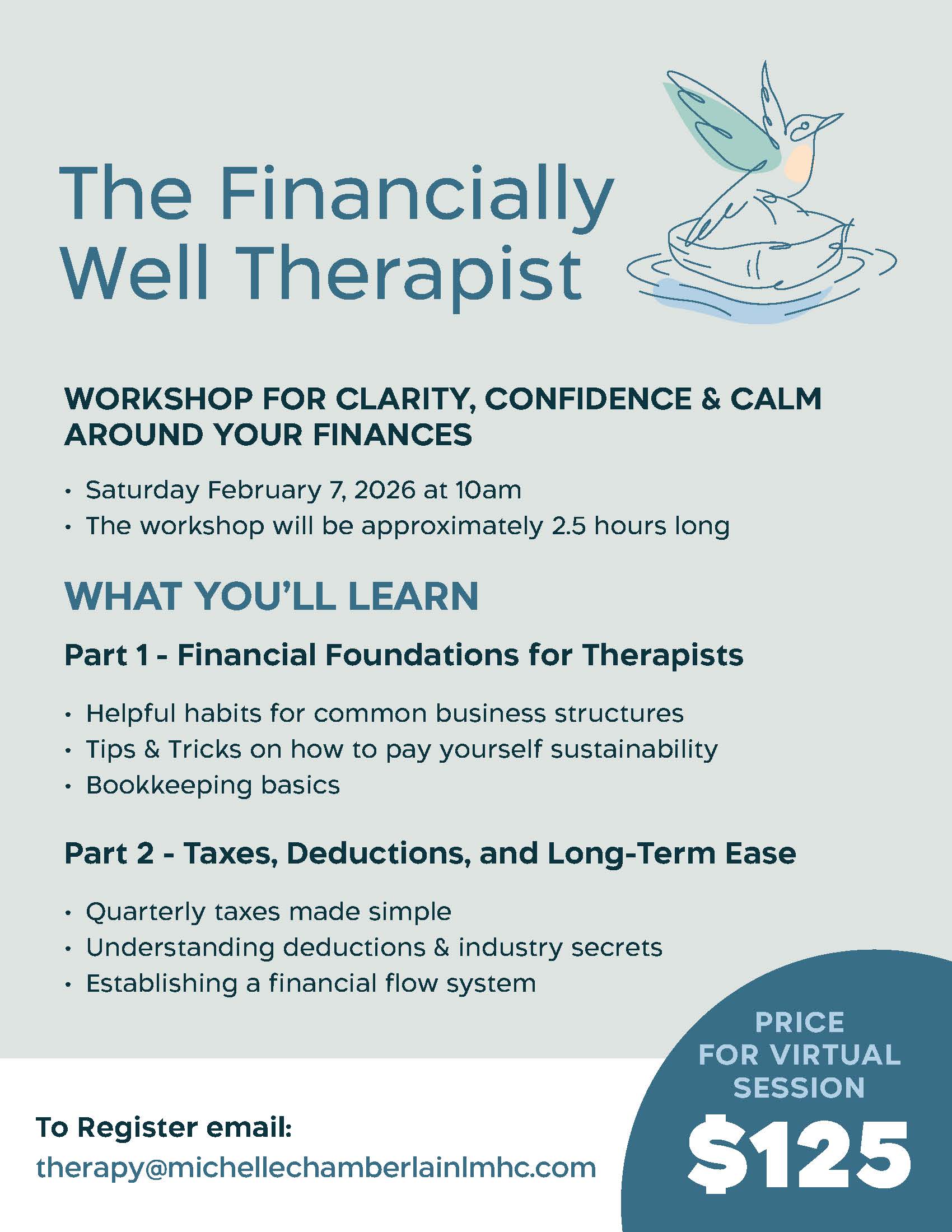
Financial Wellness for Mental Health Therapists
Money stress is one of the most common — and least talked about — sources of burnout for therapists. Graduate school didn’t teach us how to run a sustainable practice, navigate taxes, or feel confident about our finances. And yet, financial instability quietly impacts our nervous systems, our clinical work, and our longevity in the field.
My Financial Wellness Workshops are designed specifically for mental health professionals who want to feel more grounded, informed, and empowered when it comes to money — without shame, overwhelm, or jargon.
These workshops blend practical financial education with a therapeutic lens, recognizing that money is never just about numbers. We explore the emotional, relational, and systemic factors that shape how we earn, spend, save, and plan — while also providing clear, concrete tools you can actually use.
In these workshops, we focus on:
- Understanding the financial foundations of private practice.
- Taxes, bookkeeping, and planning in a way that feels manageable and
ethical. - Reducing money-related anxiety and avoidance.
- Building a practice that supports both your values and your livelihood.
- Reframing money as a tool for sustainability, not a source of guilt or fear.
A Note on My Approach
I believe financial wellness is a form of mental health care – for therapists, and by extension, for the clients we serve. When clinicians feel stable and supported, we practice differently. We last longer. We show up with more presence and less fear.
My goal is not to turn therapists into accountants or entrepreneurs – but to help you feel informed, resourced, and steady enough to build a career that truly supports your life.
Email me at therapy@michellechamberlainlmhc.com to enroll.
Therapy for Therapists
Why did you become a therapist? For many of us, we entered this field because we want to help others navigate a world that can often feel overwhelming. But what about you? You are still a human being navigating life, and holding space for others, but who holds space for you?
I encourage all my clients while they are on the road to finding a therapist to ask their therapist if they see a professional. I encourage all therapists to have their own therapists, not only to experience what their potential clients go through, but to have a place where they are completely understood. Our spouses, partners, family and friends are wonderful people, but sometimes they cannot understand the immense stress and pressure we hold. I am and will forever be grateful to my therapist and mentor for her continued guidance, empathy and the space she has created for me to self-reflect, learn and grow, not only as a therapist but as a human being.
I want this experience for you as well, and I’m looking forward to creating it with you.
Benefits of seeing your own therapist:
- Prevents burnout
- Gain Fresh Perspective
- Enhance Self-Awareness
- Process Vicarious Trauma
- Improve Skills Through Modeling
- Maintain Ethical Practices
Seeing your own therapist provides a vital space for your own mental health, growth and better client care. It can help you manage complex emotions from work, develop deeper empathy and ensure you have robust coping strategies – ultimately leading to more effective and compassionate therapy for your own clients.